
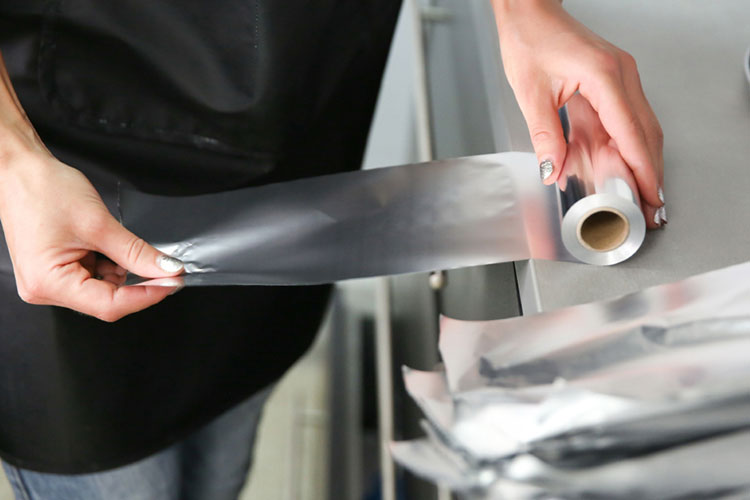
Aluminum foil is a thin, sheet-like material crafted from high-purity aluminum or premium aluminum alloys, manufactured through sophisticated hot-rolling or cold-rolling processes. With a typical thickness ranging from 0.0045 to 0.2 mm, it strikes an ideal balance between ultra-lightweight and structural integrity. It has many excellent properties, making it widely used in both industrial and daily applications.
☑ Lightweight and High Strength
Aluminum foil has low density and light weight while maintaining good strength and toughness, helping reduce overall material weight.
☑ Excellent Barrier Properties
It provides outstanding resistance to light, moisture, gases, and odors, effectively protecting product quality.
☑ Excellent Ductility and Flexibility
Aluminum foil can be easily rolled, folded, and formed, making it suitable for complex shapes and high-precision packaging.
☑ Good Corrosion Resistance
A natural oxide layer forms on the surface, offering resistance to air, water, and many chemical substances.
☑ Good Thermal and Electrical Conductivity
Aluminum foil conducts heat and electricity efficiently and is widely used in heat dissipation, insulation, and electronic applications.
☑ High and Low Temperature Resistance
It remains stable under both high- and low-temperature conditions, suitable for freezing, baking, and industrial thermal processes.
☑ Safe, Hygienic, and Non-Toxic
Food-grade aluminum foil meets safety standards and can be used in direct contact with food and pharmaceuticals.
☑ Recyclable and Environmentally Friendly
Aluminum foil is 100% recyclable, energy-saving, and environmentally friendly, supporting sustainable development.